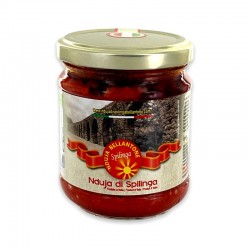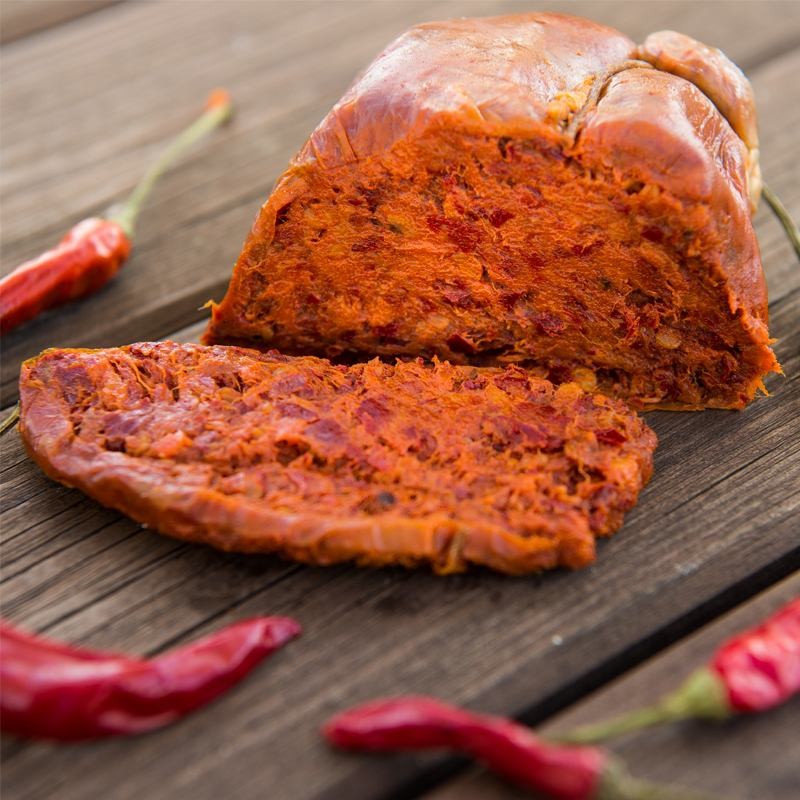
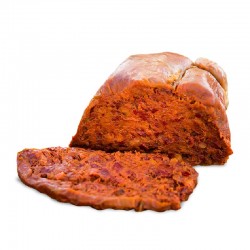
The 'nduja di Spilinga in cresponetto is a Calabrian delicacy known for its intense, spicy flavor. Artisanally crafted with selected pork meat and Calabrian chili pepper, it is encased in the cresponetto, a natural casing that enhances its aroma during curing. This specialty is perfect for spreading on crusty bread or enriching sauces and dishes, bringing the authentic culinary tradition of Spilinga to your table.
Pork fat and meat raised in Italy, Chili (30%), Salt.
'Nduja is a spreadable sausage from Calabria, renowned for its intense and spicy flavor.
The origin of its name is debated: some sources suggest a derivation from the French "andouille", a sausage introduced to Southern Italy during the Napoleonic era. Other theories link it to the Latin term "inducere", meaning "to introduce," referring to the act of stuffing meat into casings. Initially considered a "poor man's dish", 'nduja was made using less noble parts of the pig, such as spleen, stomach, and lungs, mixed with generous amounts of Calabrian chili pepper, which acted as a natural preservative.
Today, the recipe has evolved to include more prized cuts of pork, while maintaining its distinctive spiciness.
It may interest you
The 'nduja from Spilinga is a spreadable sausage typical of Calabria, renowned for its intense and spicy flavor. Artisanally produced in the town of Spilinga, located on the Poro plateau, this culinary specialty is made from a blend of selected pork cuts—mainly lard, guanciale, and pancetta—and a generous amount of Calabrian chili pepper. The chili not only imparts the 'nduja's characteristic bright red color but also plays a crucial role in preserving the product due to its antiseptic and antioxidant properties.
The preparation involves finely mincing the ingredients, which are then stuffed into a natural casing known as "crespone". Subsequently, the sausage undergoes a light smoking process using non-resinous woods such as oak, olive, or acacia, contributing to its intense and natural aroma. The curing takes place in cool, dry environments for a minimum of 45 days, during which the 'nduja develops its creamy and spreadable consistency.
Traditionally considered a "poor man's dish", 'nduja was originally made using less noble parts of the pig. However, the recipe has evolved.
'Nduja is a spicy, spreadable pork salume originating from the Calabria region in southern Italy, specifically from the town of Spilinga. The name 'nduja is believed to be derived from the French word "andouille", reflecting historical influences. Introduced during the Napoleonic period (1806–1815), it was adapted by Calabrians using local ingredients and methods.
Traditionally, 'nduja was crafted using less noble parts of the pig, such as offal and fat, combined with a significant amount of Calabrian chili peppers. This blend was then encased in natural casings, typically the "orba" (the final part of the large intestine), and underwent a light smoking process using woods like robinia or olive. The sausages were then aged in cool, dry environments for periods ranging from three to six months.
Over time, the recipe for 'nduja has evolved. Today, it is made using higher quality cuts such as pork belly and jowl, while still maintaining its characteristic spiciness from the generous use of Calabrian chili peppers. The result is a soft, creamy texture that is highly versatile in culinary applications. 'Nduja can be spread on toasted bread, incorporated into sauces for pasta dishes, or used as a flavorful addition to various recipes.
In Calabria, 'nduja holds a place of cultural pride. The town of Spilinga celebrates this delicacy annually on August 8th with the 'Nduja Festival, an event that showcases the rich heritage and culinary traditions associated with this unique salume.